


 VN
VN EN
ENFor many years, staff training has been viewed as a supporting activity to help employees quickly adapt to their roles, adhere to procedures, and enhance professional competence. However, the rapid development of artificial intelligence is transforming how work is done, how businesses organise resources, and the skills employees need to possess. As AI can assist with information retrieval, data synthesis, content creation, trend analysis, and automate repetitive tasks, training can no longer be limited to imparting existing knowledge. Instead, it must focus on enabling staff to learn quickly, think flexibly, and collaborate effectively with technology.
For the Hospitality industry, this shift holds particular significance. It is a sector characterised by high operational intensity, numerous touchpoints between staff and guests, and the continuous need for inter-departmental coordination. While AI can help businesses optimise processes, analyse customer behaviour, forecast demand, or enhance management efficiency, it cannot fully replace human capabilities such as empathy, observation skills, communication, and problem-solving. Therefore, the challenge of training in the age of AI is not about training staff to "replace" technology, but rather about building a team capable of using technology to improve work quality and create distinctive value for customers. According to The Future of Jobs Report 2025 by the World Economic Forum, technological changes, particularly in AI, information processing, and automation, are becoming one of the most significant drivers shaping the labour market up to 2030. The report is based on the opinions of over 1,000 businesses, representing more than 14 million workers across 55 economies and 22 industry sectors. In this context, reskilling and upskilling are no longer supplementary activities but are becoming a crucial part of a company's human resource development strategy.
AI is changing the nature of HR training
Previously, many training programmes were built on a linear model, where businesses defined content, organised classes, and assessed comprehension after the programme concluded. This approach might have been suitable when specialised knowledge changed slowly and job requirements were relatively stable. However, in an environment of rapid AI development, knowledge and tools can change in a short period, making long-cycle training content quickly outdated. AI is also changing how employees access and use knowledge. Instead of searching for information through multiple documents or waiting for direct guidance from managers, employees can use AI tools to summarise content, ask questions, develop solutions, or assist in solving certain work problems. This accelerates knowledge access but simultaneously creates new demands for evaluating information quality, verifying data, and responsibly using AI-generated results.

According to the World Economic Forum, approximately 39% of the current skill sets of employees are projected to change or become obsolete by 2030. The report also indicates that AI and big data are the skill groups predicted to have the fastest increase in importance, while analytical thinking, adaptability, creativity, and self-learning capabilities continue to play a core role. This suggests that HR training in the age of AI needs to be designed to combine technological capabilities with human-centric skills, rather than solely focusing on instructing how to use a specific tool.
From Position-Based Training to Skill-Based Competency Development
One of the most significant changes in HR training in the age of AI is the shift from a job-title-based training model to a skill-based development model. In the traditional model, training content was often designed for specific positions such as front desk, housekeeping, sales, HR, or operations management. However, as technology changes the scope and method of work, the same position may require new competencies or take on different tasks than before.

The skill-based training model helps businesses clearly define the necessary competencies for each job group, from specialised knowledge and digital skills to analytical and collaborative capabilities. Instead of just asking what position an employee holds, businesses need to assess what skills an employee possesses, what competencies they lack, and how they need to develop to meet future requirements. This approach makes training more flexible and helps businesses build development roadmaps tailored to each individual. Deloitte suggests that organisations can use AI to bridge knowledge and experience gaps, support upskilling employees, and create new, high-value competencies. However, businesses also need to clearly define which activities should be automated, which require active human involvement, and how to design effective collaboration between employees and technology. Therefore, training not only needs to help employees know how to use AI but also to understand when to use it, how to control the results, and what limits should not be crossed.
AI training is not just about tool instruction
A common mistake is equating AI training with organising a generative tool instruction session. While employees knowing how to write prompts, create content, or ask AI to summarise information can be a necessary first step, it is not sufficient to build the competency for applying AI in their work. Without knowledge of the business context, operational processes, and result evaluation methods, employees might use AI in an experimental, inconsistent manner, or create risks related to accuracy and information security.
Effective AI training needs to help employees develop the ability to correctly identify problems before choosing a tool. Learners need to understand the work objective, necessary input data, criteria for evaluating results, and how to verify AI-generated information. With this foundation, AI will become a tool to support thinking and enhance productivity, rather than just a solution for faster content generation. Deloitte has noted a significant gap between the demand for AI competency development and the level of investment in training by businesses. A survey cited by Deloitte shows that a lack of AI-related skills is among the top three concerns for 31% of organisations, while only 17% of organisations make significant investments in employee training and development to support their AI strategy. This gap indicates that investing in technology without commensurate investment in human capabilities can slow down AI adoption and make it difficult for businesses to transition from the experimental phase to generating real value.
Employee competencies to develop in the AI era
The first competency is a basic understanding of AI and data. Personnel do not necessarily need to become technology experts, but they must understand operating principles at a level appropriate to their work, recognise AI's capabilities and limitations, and understand why input data quality directly affects output results. This foundational knowledge helps employees avoid absolute trust in AI-generated content and develop a habit of verification before use. The second competency is critical thinking and information evaluation. AI can generate clearly structured answers and persuasive language, but not all information is accurate or relevant to the business context. Personnel need to be able to cross-reference results with real-world data, internal processes, brand standards, and business objectives. In the Hospitality environment, this requirement is particularly crucial because a seemingly logical proposal may still be unsuitable for the customer experience or operational capabilities at a specific property.

The third competency is the ability to ask questions and design effective prompts. The quality of AI-generated results largely depends on how users describe objectives, provide context, and define output requirements. Therefore, training needs to guide employees on how to break down problems, provide relevant data, and establish clear evaluation criteria. This is not just a skill in using commands but also reflects structured thinking and the ability to correctly identify problems at work. The fourth competency is the ability to combine technology with human-centric skills. According to the World Economic Forum, analytical thinking continues to be one of the highly valued core skills, while adaptability, creative thinking, self-motivation, and leadership capabilities remain crucial in the future work environment. AI can help process information at high speed, but empathy, the ability to build trust, and the capacity to handle complex situations are still factors that create distinctive human value.
How should HR training in the Hospitality industry change?
For the Hospitality industry, training in the AI era needs to start with practical scenarios rather than just theoretical introductions to technology. Front office staff can be guided on using AI to assist in compiling customer information, preparing response content, or developing communication scripts. Sales and marketing departments can apply AI in market research, customer segment analysis, idea generation, or content creation support. Meanwhile, management teams can use AI to summarise reports, analyse trends, and support decision-making processes. However, AI application must be designed to align with service standards and the specific characteristics of each business. An AI-generated response might be linguistically correct but may not suit the brand's tone or the customer's emotions in a specific situation. Therefore, training programmes must help personnel understand that AI is a supportive tool, while the ultimate responsibility for service quality remains with humans. Deloitte notes that technology in the Hospitality industry should be implemented to enhance human experience rather than diminish the personal touch in service. When repetitive tasks are supported by technology, personnel can dedicate more time to observing needs, building connections, and creating meaningful experiences. This is also a crucial principle in HR training: technology should help teams excel at tasks where humans create the highest value.
AI can enhance the effectiveness of training itself
Beyond being a subject for training, AI can also be applied to innovate training methods. Learning platforms can use data to suggest content tailored to each employee's capabilities and needs. Instead of all learners participating in the same programme at the same pace, businesses can design flexible pathways based on each individual's role, experience, and skill gaps.
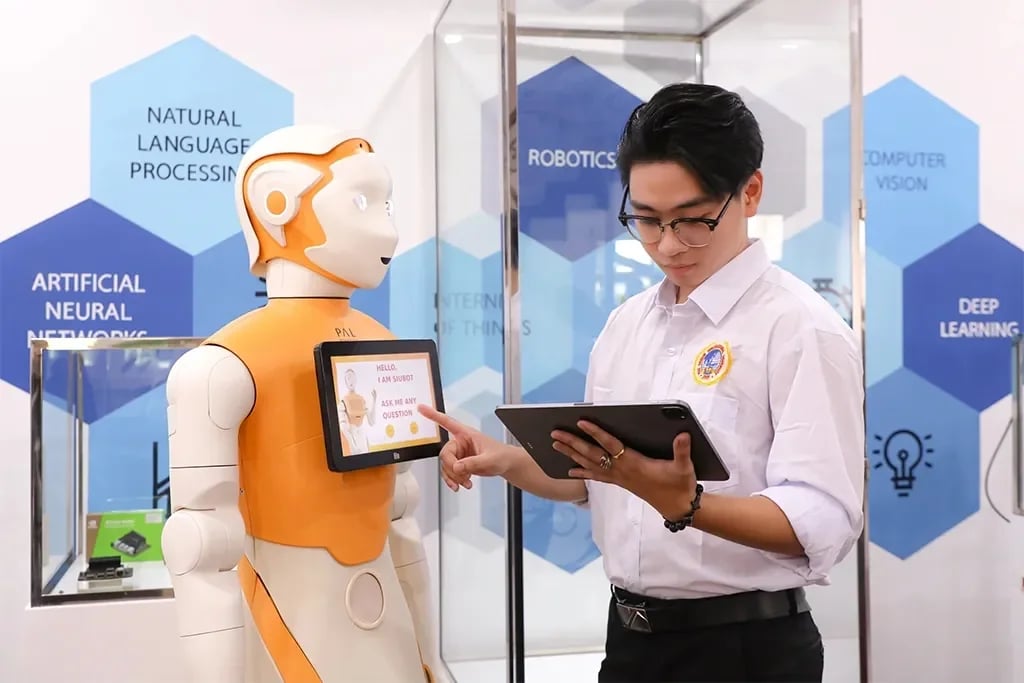
AI can also assist in developing training materials, creating simulated scenarios, formulating assessment questions, and providing initial feedback to learners. For the Hospitality industry, technology can help simulate customer interactions, complaint handling, or inter-departmental coordination. Practising in a simulated environment allows personnel to experiment with various approaches before applying them to real-world work. However, businesses should not view AI as a complete replacement for the role of trainers or managers. Effective training still requires observation, feedback, and guidance based on real-world contexts. AI can help personalise content and accelerate the learning process, but managers still play a crucial role in connecting knowledge with corporate culture, service standards, and team development goals.
Developing an HR Training Strategy for the AI Era
Businesses should begin by assessing current capabilities rather than implementing mass training programmes. This assessment should include the level of technological understanding, data utilisation skills, professional expertise, and readiness for change within each personnel group. The assessment results will help businesses identify skill gaps and prioritise skills that directly impact business objectives.

After identifying needs, businesses must develop a competency framework suitable for each job group. For frontline staff, the focus might be on using AI to support tasks, improve response speed, and maintain service quality. For management levels, programmes need to expand to include data analysis, decision-making, risk management, and coordinating human-technology collaboration. For specialist teams, training content can focus on integrating AI into operational processes and developing solutions tailored to the business's specific characteristics. Training methods also need to shift from one-way knowledge transfer to learning through real-world scenarios and projects. Personnel should practice with existing work challenges, experiment with AI usage, and evaluate results based on specific criteria. After training, businesses need to monitor the level of application, improvement effectiveness, and changes in work quality, rather than just assessing based on course completion rates. According to the World Economic Forum, 59% of the global workforce is projected to require reskilling or upskilling by 2030. Of these, 29% are expected to be upskilled in their current roles, while 19% may need to be reskilled and transition to new roles. These projections indicate that competency development should be viewed as a continuous process linked to long-term HR strategy, rather than just a periodic training activity.
Conclusion: HR training is the foundation for AI to create sustainable value
AI is opening up numerous opportunities for businesses to enhance productivity, optimise processes, and develop new service models. However, technology can only create value when the team understands how to apply it, can evaluate results, and knows how to combine AI with their professional expertise. If technology is invested in without investing in human development, businesses may acquire many tools but still struggle to translate technology into operational efficiency. For the Hospitality industry, training in the age of AI needs to maintain a balance between technological capability and human value. Personnel need to know how to use AI to work faster, analyse better, and solve problems more effectively, while still maintaining empathy, a service mindset, and the ability to connect with customers. This is the foundation that helps technology become a tool to enhance the quality of experience rather than diminish the personal touch that is inherent to the service industry. In a phase where AI continues to develop rapidly, competitive advantage will not solely belong to businesses with the most advanced technology. The advantage will belong to businesses capable of building a continuously learning team that adapts quickly and knows how to transform technology into real value. Therefore, personnel training is no longer a supporting activity but is becoming a crucial part of a Hospitality business's sustainable development strategy.
NewSun Hospitality partners with businesses to develop human resource capabilities in the age of AI.
NewSun Hospitality provides consulting and training solutions tailored to the operational specifics of hotels, resorts, and service businesses. From assessing team capabilities, building competency frameworks, designing training programmes, to developing AI application skills in the workplace, NewSun Hospitality aims to help businesses build a team with adaptive capabilities, continuous learning, and an innovative mindset. Contact NewSun Hospitality for advice on a training and human resource development roadmap suitable for your business's operational model, transformation orientation, and development goals. Start by building human capabilities, because technology can only create sustainable value when operated by a team ready for change.
- Hotline: +84 768 68 2913
- Email: dosm@nshm.com.vn
- Zalo OA: https://zalo.me/2452770272256938463 (NewSun Hospitality)
- Website: https://nshm.com.vn/ (NewSun Hospitality)
References
- Deloitte. (2025). Future of hospitality: AI-driven industry trends. Deloitte.
- Deloitte. (2025). Frontline workforce trends in airlines, hospitality, and restaurants. Deloitte.
- Deloitte. (2025). Strategies for workforce evolution. Deloitte Insights.
- Deloitte. (n.d.). Skills gaps are slowing down AI-workforce integration. Deloitte. International Labour Organization. (2025). Generative AI and jobs: A refined global index of occupational exposure (ILO Working Paper No. 140). International Labour Office.
- World Economic Forum. (2025). The future of jobs report 2025. World Economic Forum.
- World Economic Forum. (2025). New economy skills: Building AI, data and digital capabilities for growth. World Economic Forum.