


 VN
VN EN
ENWhat opportunities does Regenerative Hospitality offer the Vietnamese hotel industry?
Vietnam possesses many advantages for developing Regenerative Hospitality, thanks to its diverse natural ecosystems, rich cultural identity, and unique indigenous resources. However, for many years, most sustainable development activities by hospitality businesses have focused on operational aspects such as energy saving, reducing plastic waste, or achieving green certifications. While these are necessary steps, they are insufficient to create a distinctive edge as global tourism shifts towards a model that generates positive value. According to Savills, ESG is increasingly becoming a crucial criterion in real estate investment, with the hotel industry facing significant pressure to demonstrate sustainable operational efficiency and the ability to create long-term asset value. Projects that effectively integrate environmental, social, and governance factors have greater opportunities to access international capital and enhance their competitiveness in the market.

From a consumer perspective, Decision Lab also notes a growing trend among Vietnamese consumers towards brands that demonstrate environmental and social responsibility. Younger customer segments, in particular, tend to prioritise businesses transparent about their sustainable development efforts and are willing to support brands with clear social values. This indicates that Regenerative Hospitality not only caters to international guests but also aligns with evolving consumer behaviour in the domestic market. For hotels and resorts in Vietnam, adopting Regenerative Hospitality does not necessarily mean investing in large-scale projects from the outset. The key is for businesses to shift their mindset from "minimising impact" to "creating value". A coastal resort could collaborate with local authorities and communities to restore mangrove forests or coral ecosystems. A hotel in a mountainous region could prioritise local produce, partner with local artisans to develop cultural experiences, or provide vocational training for residents. Meanwhile, urban hotels can certainly build local supply chains, reduce food transportation distances, develop circular economy models in their operations, and organise community activities with guests. These initiatives not only enhance brand image but also create profound experiences, increasing customer engagement. In an environment where it is increasingly difficult for accommodation products to differentiate themselves based on facilities, human-centred experiences and sustainable values will become crucial competitive advantages.
How will Regenerative Hospitality change hotel operations?
Regenerative Hospitality is not a standalone project but a strategy that permeates all business operations. In the design phase, projects should prioritise local materials, preserve natural landscapes, and minimise intervention in existing ecosystems. In operations, hotels need to build a circular resource usage model, reduce carbon emissions, and optimise the supply chain. From a human resources perspective, businesses must create career development opportunities for local employees, foster a diverse and equitable work environment, and raise sustainability awareness across the entire team.
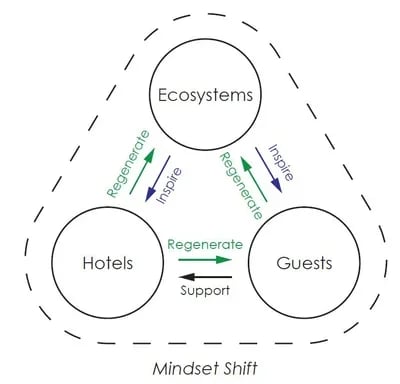
For the guest experience, Regenerative Hospitality aims to transform each stay into a journey that creates a positive impact. Guests not only relax but can also participate in reforestation activities, biodiversity conservation, learn about local culture, support community projects, or contribute to local development programmes. These experiences enhance the emotional value of the trip, increasing the likelihood of repeat visits and brand recommendations to other guests.
Challenges businesses need to overcome
Despite its immense potential, implementing Regenerative Hospitality also presents numerous challenges.

Firstly, there is the challenge of management mindset. Many businesses still view sustainable development as an expense or a PR activity rather than a long-term investment strategy. This leads to fragmented, unsystematic implementation that struggles to create real impact. Secondly, there is the challenge of measurement capability. To demonstrate the effectiveness of regenerative initiatives, businesses need to establish clear evaluation metrics for environmental, social, and governance aspects. This is also a growing requirement from investors, financial institutions, and international partners. Additionally, Regenerative Hospitality demands close collaboration between businesses, local authorities, communities, and professional organisations. The success of this model does not come from the efforts of a single hotel but depends on the collective support of the entire tourism ecosystem.
Conclusion
While Sustainability helps the hotel industry "reduce negative impacts", Regenerative Hospitality aims for the greater goal of restoring, regenerating, and creating positive value for both the environment and the community. This is no longer an experimental trend but is becoming the development direction for many leading global hotel groups. In an era where travellers are increasingly seeking meaningful experiences, investors are focusing on ESG, and destinations face pressure to conserve resources, Regenerative Hospitality is expected to become the new standard for the accommodation industry in the coming decade. For hotel businesses in Vietnam, this is the opportune moment to shift from a "green operations" mindset to one of "creating positive value". Pioneering entities will not only build a sustainable competitive advantage but also contribute to elevating the image of Vietnam's tourism industry on the international map.
NewSun Hospitality partners with businesses to build the hotel model of the future
At NewSun Hospitality, we believe that sustainable development should not merely meet ESG standards but become an integral part of a business's long-term growth strategy. With extensive experience in hotel investment consulting, operations, and management, NewSun Hospitality is ready to partner with investors in building effective business models that integrate new trends like Regenerative Hospitality to enhance asset value, elevate guest experiences, and create sustainable competitive advantages. Contact NewSun Hospitality to stay updated on the latest hotel management trends and find suitable solutions for your project.
- Hotline: +84 768 68 2913
- Email: dosm@nshm.com.vn
- Zalo OA: https://zalo.me/2452770272256938463 (NewSun Hospitality)
- Website: https://nshm.com.vn/ (NewSun Hospitality)
References:
- Booking.com. (2024). Sustainable Travel Report 2024. https://globalnews.booking.com
- Deloitte. (2024). Sustainable Consumer 2024. https://www.deloitte.com
- Deloitte. (2024). A Roadmap for Sustainable Hospitality. https://www.deloitte.com
- Savills. (2024). Hotels and ESG: Creating Long-term Value in Hospitality Real Estate. https://www.savills.com
- World Travel & Tourism Council. (2024). Environmental & Social Research. https://wttc.org
- Skift Research. (2024). The Future of Sustainable Travel. https://research.skift.com
- Statista. (2024). Sustainable Tourism Worldwide. https://www.statista.com
- Decision Lab. (2024). The Connected Consumer Report. https://decisionlab.co
- United Nations World Tourism Organization. (2024). Tourism and Sustainable Development. https://www.unwto.org