


 VN
VN EN
ENIn the post-pandemic recovery and deep restructuring phase of the hospitality industry, the market is witnessing a fundamental shift in how competitive advantage is created. While previously, factors such as location, scale, or the luxury of facilities played a central role, today, the core value lies in how hotels design and operate the customer experience at every touchpoint. According to a 2025 McKinsey report, over 65% of perceived customer value in the service industry comes from interactions throughout the experience journey, rather than from tangible products. This means that with the same room product, two hotels can create two completely different levels of value, solely based on how they operate their service processes. In this context, Process is no longer a supporting function, but is becoming a strategic lever directly determining revenue and long-term competitiveness.
However, a significant question arises: Why do many hotels still struggle to create clear differentiation, despite substantial investment in operational systems and staff training? The answer lies in a seemingly basic yet often overlooked point: service processes are not standardised into communicable SOPs. From this perspective, the article “DECODING HOTEL PROCESS STRATEGY - PART 1: WHEN PROCESSES CANNOT "TELL THE SERVICE STORY"” will comprehensively analyse this core issue. Beyond merely describing the current situation, the article will delve into systemic causes, clarify direct consequences for guest experience and revenue, and propose strategic approaches to help hotels transform processes from an operational tool into an "experience language" that guests can perceive, remember, and share.
When SOPs remain internal and "disappear" from the customer experience
Most 4–5 star hotels today, especially international brands or projects involving professional consulting firms, have established relatively comprehensive and well-structured SOP systems. From an operational perspective, this is a crucial foundation for ensuring consistency, controlling service quality, and minimising errors during service delivery. However, a notable reality is that most of these processes are still designed with an internal focus, serving internal management and control objectives, rather than being developed as a tool to create and convey experiences to guests. When a process merely fulfils its technical role of being "correct and complete" but lacks the "feeling" element, it struggles to become a foundation for building service differentiation.
This gap becomes clearer when viewed from the perspective of the people executing the process. According to a 2024 Deloitte study, up to 58% of frontline service staff do not truly understand the core objectives of the processes they perform. This leads to SOPs being implemented as a series of repetitive actions, leaning towards compliance rather than value creation. When staff do not grasp the "spirit" of the process, they struggle to convey the emotion and meaning of the service to guests. The result is a "mechanised" experience, lacking subtlety and personalisation, which are critical factors in the luxury hotel segment. In Vietnam, this picture is also clearly reflected in market data. Grant Thornton's Vietnam Hotel Survey 2024 report shows that while occupancy and revenue in the luxury hotel segment have strongly recovered post-pandemic, customer satisfaction scores have not grown proportionally, and have even shown signs of stagnation in some key markets. This indicates a significant gap between "operational efficiency" and "experiential value". When processes are not "communicated" as tangible touchpoints, guests find it difficult to differentiate between brands, thereby diminishing the ability to position and enhance service value.

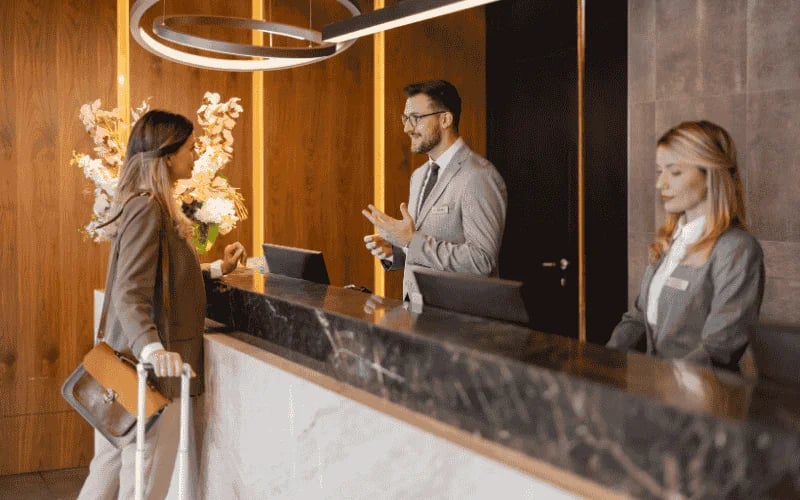
A typical example can be observed in the check-in process, which is considered the first and most crucial touchpoint in the guest experience journey. In many hotels, this process has been meticulously standardised in terms of actions, from confirming information and processing documents to handing over the room. However, if the entire process unfolds merely as an administrative procedure, lacking emotional connection through communication style, body language, or space design, the resulting experience will struggle to make an impression. In such cases, no matter how "correct" the process is, it will not be enough to become a "memorable moment" in the guest's mind, nor will it be strong enough to clearly contribute to building the brand story.
Why processes fail to become experiences
To understand the issue, it is necessary to examine the core reasons from strategic and operational perspectives. 1. Processes are built from the inside out, not from the customer Most SOPs are designed based on organisational structure and internal control needs, rather than originating from the customer experience journey. This results in processes that are optimised for operations but not for customer perception. According to PwC, only about 34% of service businesses truly design processes based on the customer journey.
2. Lack of an "experience interpretation" layer in SOPs Many SOPs merely describe "what to do" without answering "how to make the customer feel the value". According to Harvard Business Review, successful service businesses often integrate emotional elements and storytelling into operational processes, helping to transform each action into part of the brand experience. 3. Staff are not empowered to flexibly deliver service When SOPs are too rigid, frontline staff are confined to operational frameworks, with no room to adapt to specific situations. This makes the experience uniform but lacking personality. A 2025 Salesforce report shows that 73% of customers expect personalisation, but most businesses fail to deliver due to process limitations.
4. Lack of connection between process and brand In many hotels, SOPs and brand positioning exist as two separate systems. This means the service experience does not accurately reflect the brand identity. A hotel positioned as luxury but with mechanical service processes will struggle to create consistency in customer perception. 5. Processes are not yet integrated with data and technology When processes are not supported by customer data, personalising and optimising the experience becomes limited. According to a McKinsey report, businesses that apply data to operations can increase customer satisfaction by up to 20%.
When processes don't "tell a story", revenue will be limited
Failing to translate SOPs into tangible experiences is not merely an operational limitation; it leads to strategic consequences that directly impact a hotel's long-term revenue growth potential. Firstly, the most evident consequence is a decline in the ability to build brand differentiation. When experiences are not distinct enough and fail to leave a lasting impression, customers tend to make decisions based on "tangible" and easily comparable factors such as room rates or location. This traps the hotel in a price competition spiral, rather than competing on value. According to STR Global, hotels with high customer experience scores typically achieve 10% to 20% higher RevPAR than the average. Conversely, when processes are not "communicated," the ability to optimise room rates is limited, leading to pressure to increase occupancy by reducing prices, thereby directly affecting profit margins.
Secondly, customer loyalty tends to decline when experiences are not sufficiently distinct to create memorability. A Bain & Company report indicates that increasing customer retention by 5% can boost a business's profits by 25% to 95%. However, this can only be achieved when customers have an experience impressive enough to encourage repeat visits and recommendations. A purely functional SOP, even if executed correctly, struggles to evoke emotion without personalisation and a "service story." When customers have no clear reason to remember a hotel, they also lack the motivation to return, especially in an increasingly diverse and competitive market. Thirdly, word-of-mouth effects and viral value on digital platforms are significantly diminished. In the digital age, every experience has the potential to become shareable content, from reviews on Google and TripAdvisor to social media platforms. A 2024 BrightLocal survey found that 87% of consumers consult online reviews before booking services. In this context, an experience with "nothing to tell" means the hotel is missing an opportunity to build its brand image through its own customers. Conversely, even small, distinctive experiences can create a powerful viral effect at almost no cost.
Finally, operating costs tend to increase when processes are not designed to optimise the experience. When customers are dissatisfied, the number of complaints and support requests rises, leading to processing costs, staff time, and the risk of negative situations. According to PwC, businesses with poor customer experience incur 20% to 30% higher service costs than those with good experiences. Beyond direct costs, incomplete experiences also increase opportunity costs by losing potential future customers. When processes cannot "tell a story," hotels not only miss the opportunity to create a differentiated experience but also limit their revenue growth potential. In a market where experience is becoming the decisive factor, redefining the role of SOPs from "operational procedures" to "value creation tools" is no longer an optional improvement, but a strategic imperative.
From SOP to "Service Signature": A Strategic Approach for Hotels
To address this issue, hotels need a systematic approach where processes are not just operational tools but become part of the brand and revenue strategy. The first step in this transformation is to redesign SOPs based on the customer journey, rather than internal operational structures. This requires businesses to deeply analyse each stage of the guest journey, from before booking, during their stay, to after departure, to clearly identify each touchpoint and the experiential value that needs to be conveyed. In this way, processes are no longer built according to the logic of individual departments but are connected into a continuous flow, ensuring consistency in the customer's perception. This is also the core philosophy in NewSun Hospitality's strategic consulting and operational concept development services, where each SOP not only serves operations but is also "encoded" to reflect the brand positioning and business objectives of each project. A check-in process, for example, is not just about completing arrival formalities, but also an opportunity to convey service style, brand personality, and create a first impression with the customer.

Next, a crucial layer of value that needs to be added to SOPs is "experiential communication". While traditional SOPs focus on describing "what to do", new-generation SOPs must also answer "how to make customers perceive value". This includes clearly defining communication methods, body language, tone of voice, service pace, and even small emotional details in each interaction. According to Harvard Business Review, successful service businesses often design processes as an "experience script", where every action contributes to building a consistent brand story. This is the shift from "Standard Operating Procedures" to "Service Signature", where each process not only ensures standardisation but also creates a distinct impression, helping customers easily recognise and remember. Alongside process redesign, the human element plays a decisive role in "activating" the experience. An SOP, no matter how well-designed, can hardly be effective if frontline staff merely execute it mechanically. Therefore, training and empowering staff must be considered an inseparable part of the Process strategy. Modern training programmes not only focus on operational skills but also help staff understand the "spirit" of the process, the reasons behind each action, and how to flexibly adapt in specific situations. According to a Deloitte report, service businesses with a high degree of empowerment for frontline staff can improve customer satisfaction by up to 20%. This is also the approach in NewSun Hospitality's operational training programmes, where staff are not only guided to "do it right" but also equipped with the capability to "do it well" and "do it differently".

Finally, technology and data serve as the foundation for enhancing process efficiency and adaptability in the new context. When integrated with systems such as PMS, CRM, or customer experience management platforms, SOPs can be "activated" based on real-time data, thereby enabling personalised service at scale. According to McKinsey, businesses that apply data to operations can increase customer satisfaction by 15% to 20%, while significantly reducing operating costs. NewSun's system consulting and operational set-up solutions aim to build a flexible process ecosystem where data not only serves reporting but also becomes "input" for real-time experience adjustment and optimisation.
Conclusion: Processes are not just for operations, but for creating value
In an increasingly competitive landscape, service processes are no longer a backstage element but have become a core part of the customer experience. An SOP is only truly valuable when it can "tell a story," helping customers feel the difference and remember the brand. For hotels, shifting from an operational mindset to an experiential mindset in process design is no longer an option, but a prerequisite for enhancing revenue and competitiveness. If your business is seeking a systematic approach to restructure its process system and elevate service experiences, NewSun Hospitality can be a strategic partner on this journey.
- Hotline: +84 768 68 2913
- Email: dosm@nshm.com.vn
- Zalo OA: https://zalo.me/2452770272256938463 (NewSun Hospitality)
- Website: https://nshm.com.vn/ (NewSun Hospitality)
References
- McKinsey & Company (2025). The Future of Hospitality Experience.
- Deloitte (2024). Hospitality Industry Outlook.
- Grant Thornton (2024). Vietnam Hotel Survey 2024.
- PwC (2024). Experience is Everything.
- Harvard Business Review (2023). Designing Service Experiences.
- Salesforce (2025). State of the Connected Customer.
- Bain & Company (2023). Customer Loyalty in Hospitality.
- BrightLocal (2024). Local Consumer Review Survey.